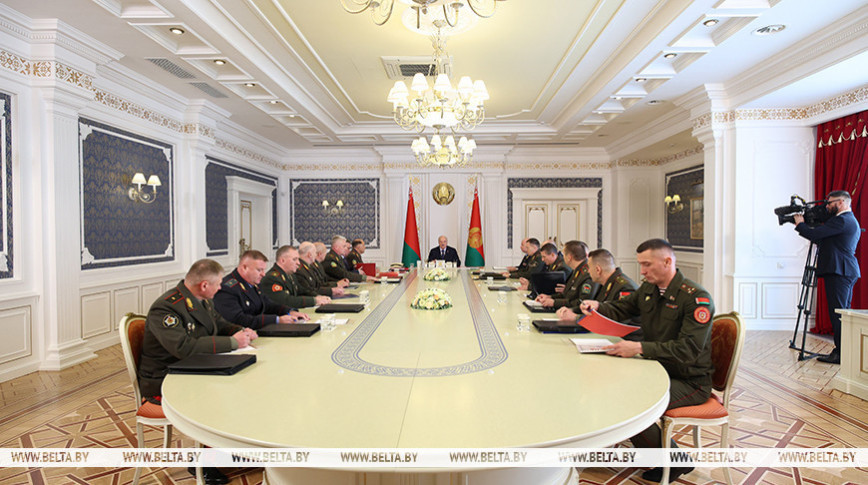
Lukashenko convenes meeting to review inspection of internal troops brigade
Belarusian President Aleksandr Lukashenko convened a meeting to review the results of the combat and mobilization readiness inspection of the 7th Separate Special Police Brigade of the Internal Troops of the Ministry of Internal Affairs, BelTA has learned.
The meeting hosted by the head of state brought together the chiefs of security agencies, including the State Secretariat of the Security Council, the Prosecutor General’s Office, the Ministry of Internal Affairs, the Defense Ministry, and the State Security Committee (KGB).
Opening the meeting, the head of state immediately emphasized that the conversation would be wide-ranging and would touch upon the provision of national security as a whole. In this regard, he pointed out that, on his instructions, inspections are being conducted not only of the army but also of the internal troops, one of whose units was inspected just recently. “What did we want to see as a result of these inspections? First, the capability to bring a formation, including the internal troops, to full combat readiness within the established timeframes. Second, the readiness of the military formation to act as designated, the level of training of servicemen to perform the tasks assigned to them,” the president emphasized. “Third, the most important thing is whether we will be able to react in a timely and adequate manner to any situation threatening national security.”
As the state secretary of the Security Council reported, in accordance with the inspection plan, no allowances were made for the servicemen. “That is what I was told, but I have other information. We will talk about it,” Aleksandr Lukashenko noted.
“I kept a close eye on every stage of the snap inspection, and I even saw things you did not want me to see. I was informed about the interim results by the state secretary, and not only by him,” the head of state emphasized. “Today we have results that give us food for thought regarding the further development of the forces – not only negative results.”
Similar inspections are currently ongoing in the Armed Forces as well. Following their results, the president instructed State Secretary of the Security Council Aleksandr Volfovich to submit a comprehensive and detailed report.
Aleksandr Lukashenko explained the purpose of regular inspections and training, particularly for personnel who would be called up from the reserves in wartime. “I will not hide it from my potential adversaries in a future conflict, God forbid, of course, but I constantly remind the defense minister that we must designate specific strategic points across the country where the Armed Forces can deploy instantly, within 24 hours, and occupy these locations, which our logistics in Belarus allow us to do. These are fortified areas. There is a certain number of them on the western border,” Aleksandr Lukashenko said. “Every serviceman needs to know his exact position, especially those mobilized from the reserves. I remember this clearly from my own military service. We were trained back then: if anything happens, you must be in that trench with that exact weapon. This is what we are doing today, so that our servicemen know which direction to operate in. They should be called up more than once, visit this fortified area, and know with what weapon they will defend our country.”
“Our rivals must realize that we know our Belarus well. We know exactly where tanks can navigate forested and swampy terrain and where they cannot. If they can’t pass, we know where they will try to go,” he stated. “We clearly understand where to deploy the Armed Forces.” In this regard, the president pointed out that under current conditions, it would be impossible to build roads through swamps, as was done at the beginning of Operation Bagration in 1944. Modern weapons, drones in particular, would not allow this. Thus, there is a clear understanding of where a potential enemy might cross the border.
“That is where we must block everything. It is simple and clear, there is no need for any grand strategy on the part of the Defense Ministry. I want to emphasize that this is very important for those whom we will call up from the reserves, so that they know where they should be,” he said. “Because Karpenkov [Deputy Minister of Internal Affairs and Commander of the Internal Troops Nikolai Karpenkov] will redeploy his mobile detachments to where they are needed within a few hours. But after replenishing their units and undergoing combat coordination, the conscripts must know exactly which trench they will be in.”
“I am saying this so that the Defense Ministry and the minister understand what I want from you. This is not even the experience of the special military operation in Ukraine – this is standard experience in the Armed Forces. We are practicing this and must practice it carefully, without haste,” the Belarusian leader added.
Aleksandr Lukashenko suggested that the meeting participants examine the problematic issues uncovered during the inspections without sugarcoating or theorizing, and also determine measures to eliminate them.
As reported earlier, under the inspection plan, the 7th Separate Special Police Brigade of the Internal Troops of the Ministry of Internal Affairs was placed on high alert with mandatory replenishment of personnel. To create a realistic combat environment, special forces personnel from other security agencies acted as the opposing force. The inspection also aimed to analyze how the experience of modern military conflicts is being implemented in the unit, how non- traditional methods of countering hybrid threats are utilized, and what measures are taken to maintain public order.